Deutsch
 English
 Chinese
Visiting Tribhuvan University and Engineering Geological Fieldwork in Nepal Himalaya
1. BACKGROUND
A Visit of Prof. Dr. Michael Z. Hou from the Institute of Subsurface Energy Systems (ITE), Clausthal University of Technology, Germany to Tribhuvan University of Nepal and engineering geological excursion in the Himalaya was initiated as a secondment of the Marie Skłodowska-Curie Actions (MSCA) Staff Exchanges Program “Localization in Geophysics, Geohazards and Geoengineering (LOC3G–101129729)”.
It is a part of the Horizon Europe program, funding international and inter-sectoral research mobility to foster knowledge transfer and innovation. The program is designed to facilitate short-term, secondment-based collaboration between academic and non-academic organizations (like SMEs) to turn research into products and strengthen skills. The aims of the project are to promote collaborative research and innovation projects, encourage knowledge sharing, and strengthen long-term partnerships across borders and sectors; and open to all research domains, facilitating mobility for staff (researchers, technical, administrative to gain new skills.
The “LOC3G” Project of European Commission consists of a consortium of Beneficiary Partners from Europe and Associate Partners from different universities across the globe. The current secondment visit is a cooperation between one of the beneficiary partners from Clausthal University of Technology, Germany and Associate Partner, Tribhuvan University (TU), Nepal. The visit involved formal interaction with high level authorities (Vice-Chancellor, Rector) and other staff members of TU, Center for International Relations, Central Library and Central Department of Hydrometeorology in Kirtipur, Kathmandu. Tribhuvan University is the leading university, which was established in 1959 and is the oldest and the largest university in Nepal. Moreover, engineering geological excursions were performed across the diverse landscapes in different parts of Nepal Himalaya to understand the engineering challenges associated with prevailing geohazards that are affecting on engineering infrastructures and human life.
2. UNIVERSITY VISIT AND FIELDWORK
The secondment under framework of European Commission “LOC3G” Project has been enriched by the official visit to Central Office of Tribhuvan University, geo-heritage sites, and understanding of geohazard conditions in diverse geo-environment of the Himalayan region.
2.1 Meeting and Visit to Tribhuvan University
A visit to the Tribhuvan University of Nepal is important aspect of the secondment. The Tribhuvan University (TU) is the first and foremost university of Nepal and was established in 1959 as an autonomous institution with novel aims of creating and disseminating knowledge emphasizing on research and strengthening Nepalese heritage through University Campus, 62+2 constituent and 1054 affiliated campuses. The university embodies nearly 80% of the total student population enrolled in higher education in the country. It has contributed to governmental and I/NGOs and civil societies in policy formulation, implementation and reform through its evidence-based research. The TU has 5 Institutes and 4 Faculties. Faculties and Institutes are performing the leadership role in conducting academic programs whereas the research centers are playing pivotal role for research as needs of national context and international visibility.
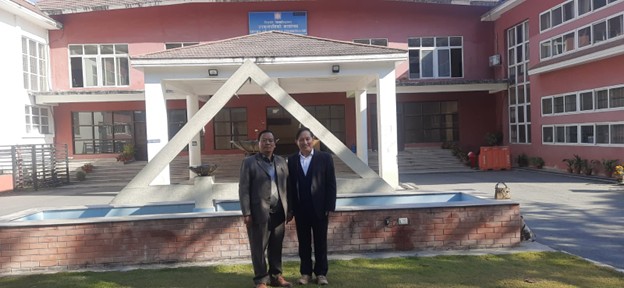
Prof. Hou officially met with Vice-Chancellor, Rector and Director of Center for International Relations of Tribhuvan University to exchange institutional information between the universities. Potential collaboration in geohazard and risk assessment in the Nepal Himalaya is highlighted.
A comprehensive observation to Tribhuvan University Central Library (TUCL) was performed with meeting Head and other staff members. The TUCL is considered as the largest focal library in Nepal and was established in 1959 to strengthen the teaching, study and research as per needs of the university campus. It has extended its services beyond the limit of the university campus and offer memberships even to the public as well as to the foreigners residing in Nepal. The massive Gorkha Earthquake that struck Nepal in April/May 2015 had severely damaged the library in many ways; however, the services are provided continuously to all its members, visitors, the university administration.
2.2 Fieldwork for Geohazard Assessment
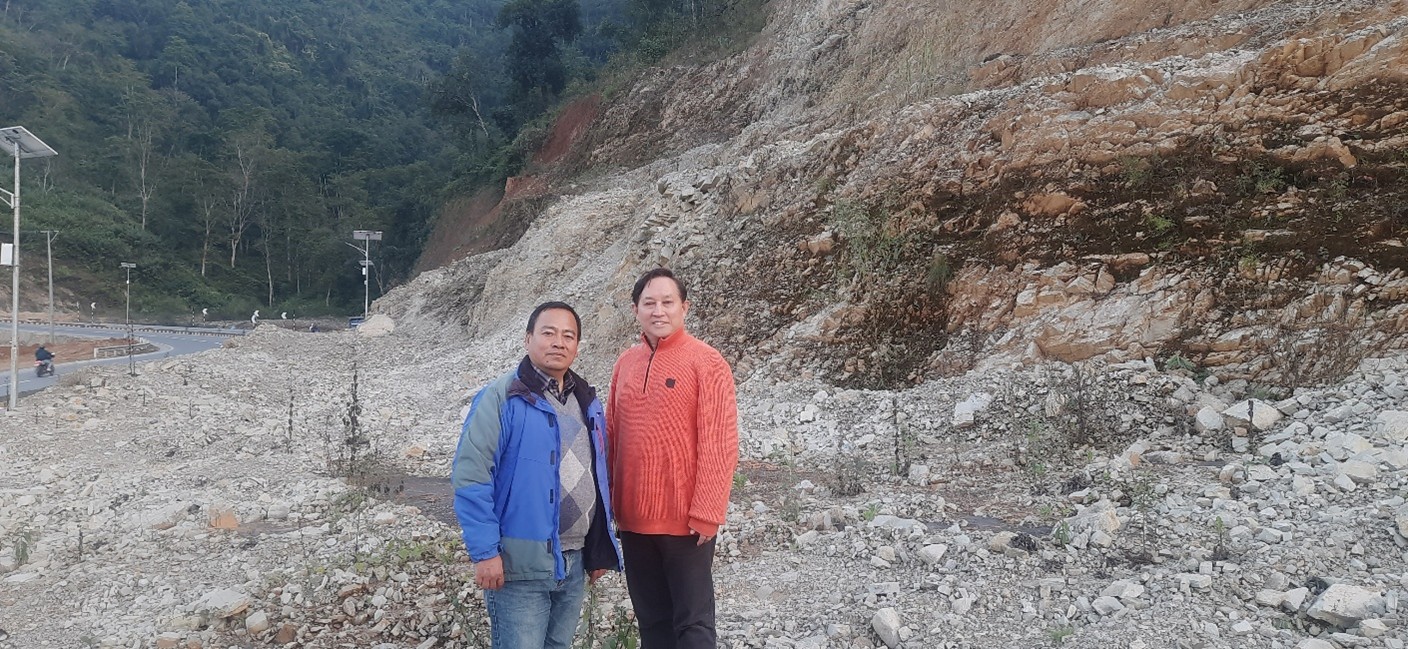
An intensive fieldwork was participated by Prof. Hou together with cooperation partner Prof. Thapa of Tribhuvan University and his research associates. The traverses were along major highways and road corridors of Nepal that have east-west to north-west stretches. Aim of observations during the field visits were to investigate the underlying challenges to infrastructures and livelihoods by the prevailing geohazards in complex geo-environment of Nepal Himalaya.
(a) Slope Protection Works
Slope protection works are implemented in Nepal ranges from low-cost to reinforced structures. Implemented anchors with pre-stressed slab that failed along national highway was investigated.
(b) Cut Slope Stability Evaluation
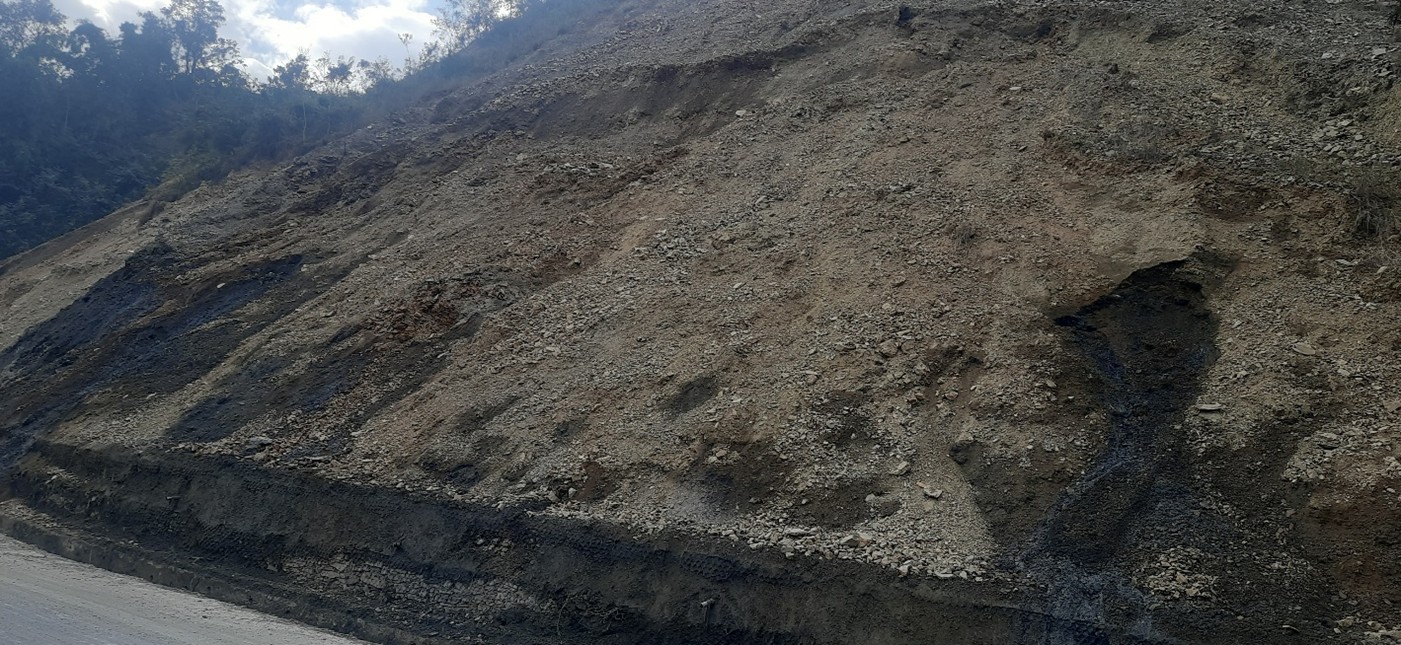
The evaluation of cut slope stability is crucial concern in the differential engineering geological conditions due to rapidly expanding road networks in the hilly regions. Prof. Hou examined the cut slopes to provide a judgement on probable stability and elaborated on the critical failure mechanisms and sustainability of engineering works to adopt with. The onsite discussion is very practical applications that compared techniques implemented in Europe such as in Germany and developing countries in Nepal.
(c) Geological Features
The geological features in Nepal Himalaya are formed due to tectonic process of ongoing collision consisting of four major zones (Siwalik, Lesser Himalaya, Higher Himalaya and Tibetan Tethys) and these zones are separated by major thrusts (HFT, MBT, MCT).
The excursion routes pass through various rock units of Nepal Himalaya basically Lesser Himalaya and Siwalik Group. Major engineering geological features and rock types found are alluvium deposit, sandstones, conglomerate, mudstone, limestone, calcareous quartzite with primary structure i.e. ripple marks, secondary structure (plumose on joints).
(d) Low-cost Slope Stabilization and Bioengineering
Slope failures occur during and after rainfall events are frequently related to cut slopes and those slopes are frequently managed by low-cost technologies such as bioengineering works, surface drainages, erosion control discharge channels and gabion walls, etc.
(e) Slope Failures and Landslides
Slope failures and landslides were observed in the fieldwork that were due to combined influence of slope geometry, complex geology, and human interventions. Some landslides are controlled by discontinuities in rocks e.g. major joint sets daylighting to slope face, faults/thrusts.
(f) Engineering Projects
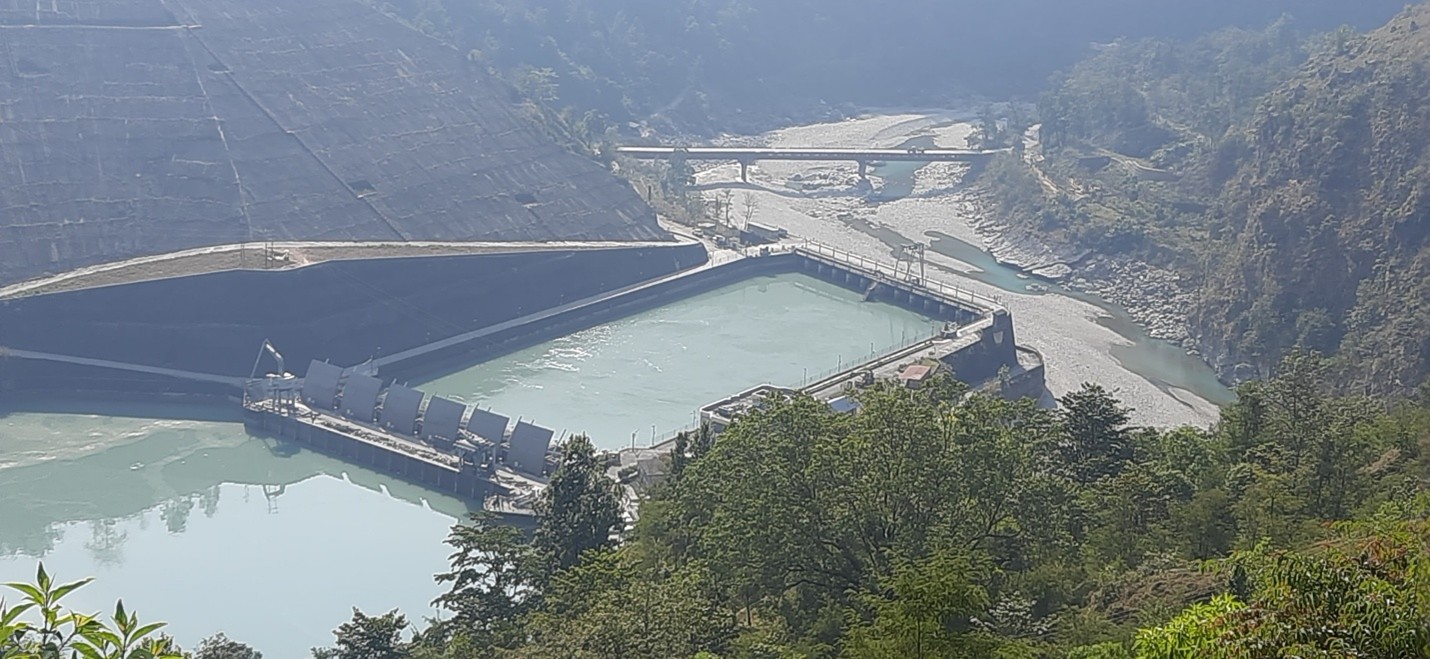
The Kali Gandaki "A" Hydroelectric Project with capacity of 144 MW was observed which is pondage power plant located in western Nepal. This engineering hydropower project was completed in 2002. It was formerly Nepal's largest power station, featuring a 43 m high dam, a 6 km tunnel, and three 48 MW Francis turbines generating roughly 842 GWh annually.
(g) Experiencing Rock-cliff Bungee Jumping and Community Perception
Experiencing rock-cliff site stay was amazing which is the Nepal’s highest bungee and the world’s second-highest bungee jump at the height of 228 m. This jump spot is connected by the 520 m suspension bridge in the George of Kaligandaki River. The gorge along river course has variable heights and is known to be the deepest gorge of the world in this river basin.
During the trip, Prof. Hou enjoyed with local people about their lifestyle in remote villages and it is a wonderful moment to get friendly gestures from them. The people in Nepal generally perceive tourists positively, and often holding a "Guest is God" attitude.
3. CONCLUDING REMARKS
The intensive visit to Tribhuvan University and fieldwork in the framework of staff-exchange program of European Commission Project “LOC3G–101129729” concluded the inspiration of the Himalayan landscape that leaves an everlasting memory and understanding geohazards phenomena in the Nepal Himalaya. Thus, it is important to address the potential issues of geotechnical and engineering geological resolution through prospective innovative research. The avenue of academic growth for promoting collaboration between Tribhuvan University and Clausthal University of Technology is perceived to explore further geohazard assessment, evaluation, and also their associated cascading risks.